




For most enterprises, the question is no longer whether to modernise infrastructure—it’s how soon they can afford to do it. Legacy systems have become one of the biggest hidden expenses in modern organisations. They slow down innovation, inflate operational costs, and create risks that compound every year.
Infrastructure Modernisation, therefore, is a business imperative. The organisations that modernise early consistently outperform those that wait, both in cost efficiency and in their ability to innovate.
The True Cost of Legacy Systems
Most organisations dramatically underestimate what their legacy estate actually costs them. Research shows that enterprises waste more than $370 million annually on legacy inefficiency, with technical debt compounding at around 20% every year. In many industries, between 60–80% of IT budgets are consumed just to keep outdated systems running, leaving only a fraction available for innovation.
When legacy systems absorb this much spend, modernisation becomes the only path to reclaiming budget for strategic initiatives.
The cost of inaction is even more striking. A 2024 Deloitte Banking survey found that actual legacy TCO often runs 3.4x higher than initial estimates once compliance overhead, integration friction, and innovation drag are included. This means that organisations budgeting modestly for legacy maintenance are often paying far more than they realise.
Modernisation reverses this trend by reducing total cost of ownership (TCO) in measurable ways. Independent analyses consistently show that cloud‑modernised environments deliver 30–40% TCO reduction, with positive ROI typically achieved within 18–24 months.
These savings come from multiple sources: reduced maintenance drag, elimination of expensive licensing tied to legacy hardware, improved resource utilisation, and the shift from Capex‑heavy infrastructure to Opex‑based cloud models.
Unlocking Innovation
Legacy systems also restrict how fast organisations can build, deploy, and scale new products. They slow down development cycles, limit experimentation, and make it difficult to adopt modern capabilities such as AI, real‑time analytics, IoT, and edge computing.
Modern infrastructure, by contrast, enables continuous innovation. Cloud‑native architectures allow teams to deploy features faster, scale seamlessly, and integrate advanced technologies without friction. This combination of speed and efficiency is what gives modern enterprises their competitive edge.
Modernisation reduces operational overhead, accelerates delivery cycles, and improves resilience. These outcomes translate directly into business value — faster time‑to‑market, higher customer satisfaction, and the ability to compete in rapidly evolving markets.
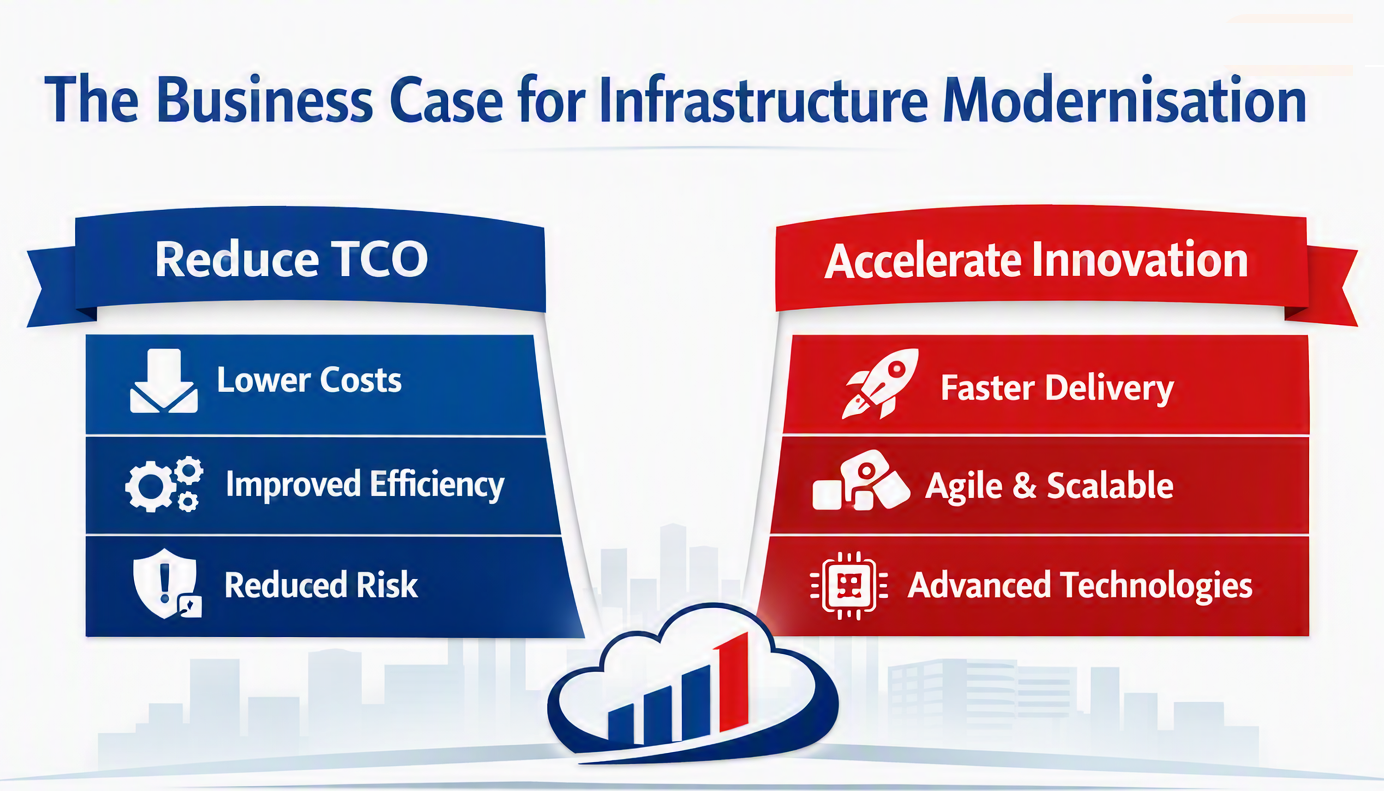
The Business Case for Infrastructure Modernisation
Throughout an organisation’s modernisation journey, cost savings accumulate as legacy systems are retired, licensing is reduced, and cloud‑native efficiencies take hold. Most enterprises see meaningful financial impact within the first year, with full ROI achieved within two years.
Plus, modernisation sets the stage for future growth. Once infrastructure is cloud‑optimised, organisations can adopt AI, automation, and advanced analytics without the constraints of legacy systems. They can expand globally with multi‑region deployments, build digital platforms faster, and respond to market changes with agility.
The business case is clear: modernise to reduce cost, modernise to accelerate innovation, modernise to stay ahead. For organisations ready to take that step, the opportunity is enormous—and the time is now.
Photo courtesy: Growtika