




For many enterprises, the biggest barrier to innovation isn’t a lack of ideas or ambition. It’s the weight of legacy infrastructure — systems built for a different era, running on assumptions that no longer match the speed, scale, and intelligence modern businesses require.
As organisations push toward digital transformation, they often discover that their infrastructure is the constraint holding everything back. Applications slow down, deployments take longer, outages become more frequent, and costs quietly rise. The business wants to move faster, but the foundation simply cannot support the pace.
Infrastructure modernisation is how enterprises break free from these constraints. It is not a technical upgrade; it is a strategic shift that enables agility, resilience, cost efficiency, and continuous innovation.
At Simplex Services, we’ve seen organisations transform their operating models, unlock new revenue streams, and accelerate product delivery… all by modernising the foundation they run on. The journey from legacy to cloud‑optimised is not instantaneous, but it is predictable when approached with clarity and structure.
From Legacy to Cloud-Optimised
The first step in any modernisation journey is understanding where the organisation stands today. Cloud maturity is not binary; it exists on a spectrum. Some organisations are still exploring cloud possibilities, while others have begun migrating workloads or experimenting with cloud‑native architectures.
A maturity assessment helps identify gaps across technology readiness, operational processes, governance, security, and organisational alignment. This clarity ensures that modernisation is not a leap into the unknown, but a structured evolution grounded in reality.
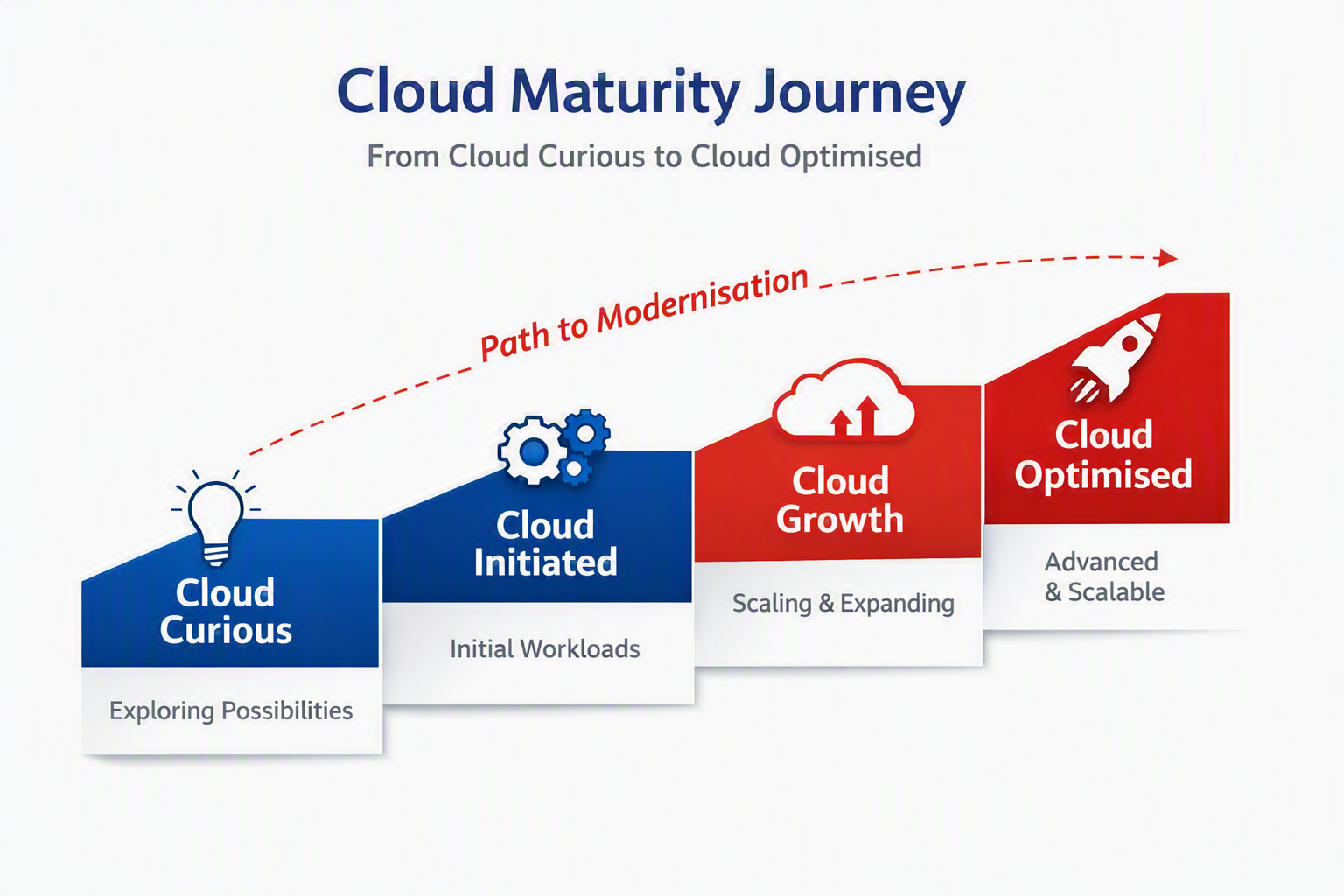
Once maturity is understood, the next critical step is leadership alignment. Modernisation succeeds when business and technology leaders move in sync. With leadership aligned, enterprises must conduct a full inventory assessment. A comprehensive inventory reveals what exists, how it behaves, what it costs, and how it should evolve. This becomes the blueprint for workload placement — deciding what to rehost, replatform, refactor, or retire.
Contrary to popular belief, modernisation is not “lift‑and‑shift everything to the cloud.” In fact, lift‑and‑shift should be a last resort. The right strategy varies by workload. Some applications benefit from quick rehosting, while others require replatforming to managed services or refactoring into cloud‑native architectures. In some cases, the best decision is to retire outdated systems entirely. A thoughtful strategy ensures cost efficiency while enabling innovation where it matters most.
Security and governance must be embedded into the design from the beginning. Modern infrastructure requires strong identity and access management, automated policy enforcement, observability, and disaster recovery planning.
The real transformation begins when enterprises build cloud‑native capabilities. Cloud‑native architectures enable modularity, scalability, and continuous delivery. These capabilities reduce operational overhead, accelerate release cycles, and create systems that evolve with business needs. Cloud‑native is where modernisation delivers its biggest benefits.
To sustain this transformation, organisations must establish a Cloud Centre of Excellence (CoE). A CoE ensures modernisation isn’t a one‑time project but a continuous capability. It provides architecture standards, governance frameworks, reusable templates, best practices, and cross‑functional alignment.
Building a Foundation for Continuous Business Innovation
With strategy, architecture, and governance in place, migration becomes predictable. A phased approach reduces risk and builds confidence across the organisation. Early wins demonstrate value, while later phases deepen capability and expand impact.
Infrastructure modernisation is how enterprises stay competitive in a world defined by speed, intelligence, and resilience.
At Simplex Services, we help organisations modernise with clarity, confidence, and predictable outcomes. If your infrastructure is slowing down your ambition, it’s time to modernise your foundation — and your future.
Photo courtesy by Liam Briese